


RUVIEW: HOW TO SEE PEOPLE THROUGH WALLS USING WIFI

Ruview:
See the article and code on Github here: https://github.com/ruvnet/RuView
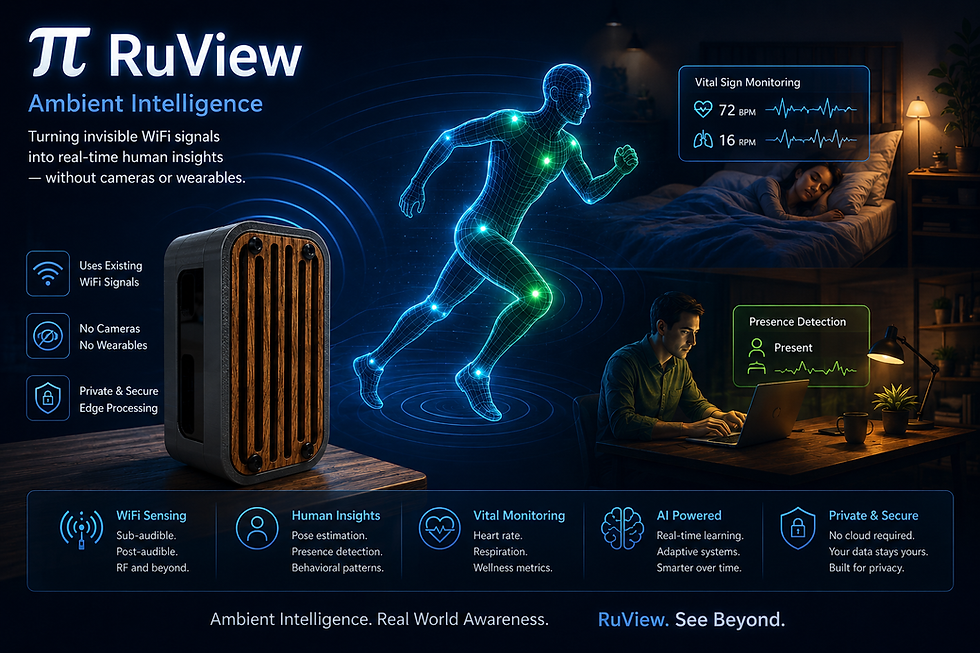
See through walls with WiFi
Turn ordinary WiFi into a spatial intelligence / sensing system. Detect people, measure breathing and heart rate, track movement, and monitor rooms — through walls, in the dark, with no cameras or wearables. Just physics.
Works natively with the four major smart-home ecosystems: Home Assistant via the HA-DISCO MQTT publisher, Apple Home & HomePod as a discoverable HAP-1.1 bridge, Google Home + Amazon Alexa via the same HA bridge or a Matter endpoint. Siri, Google Assistant, and Alexa can voice presence and vitals by room with zero custom skills.
Drop into any Home Assistant install with one --mqtt flag. Or pair into Apple Home / Google Home / Alexa / SmartThings as a Matter Bridge. Ships 21 entities per node (11 raw signals + 10 inferred semantic states: someone-sleeping, possible-distress, room-active, elderly-inactivity-anomaly, meeting-in-progress, bathroom-occupied, fall-risk-elevated, bed-exit, no-movement, multi-room-transition) plus 3 starter HA Blueprints. See docs/integrations/home-assistant.md · ADR-115.
π RuView is a WiFi sensing platform that turns radio signals into spatial intelligence.
Every WiFi router already fills your space with radio waves. When people move, breathe, or even sit still, they disturb those waves in measurable ways. RuView captures these disturbances using Channel State Information (CSI) from low-cost ESP32 sensors and turns them into actionable data: who's there, what they're doing, and whether they're okay.
What it senses:
Presence and occupancy — detect people through walls, count them, track entries and exits
Vital signs — breathing rate and heart rate, contactless, while sleeping or sitting
Activity recognition — walking, sitting, gestures, falls — from temporal CSI patterns
Environment mapping — RF fingerprinting identifies rooms, detects moved furniture, spots new objects
Sleep quality — overnight monitoring with sleep stage classification and apnea screening
Built on RuVector and Cognitum Seed, RuView runs entirely on edge hardware — an ESP32 mesh (as low as $9 per node) paired with a Cognitum Seed for persistent memory, cryptographic attestation, and AI integration. No cloud, no cameras, no internet required.
The system learns each environment locally using spiking neural networks that adapt in under 30 seconds, with multi-frequency mesh scanning across 6 WiFi channels that uses your neighbors' routers as free radar illuminators. Every measurement is cryptographically attested via an Ed25519 witness chain.
RuView turns ordinary WiFi into a contactless sensor. A $9 ESP32 board reads the radio reflections off the people in a room, and a small pretrained model — published on Hugging Face at ruvnet/wifi-densepose-pretrained — tells you who's there, how they're breathing, and how their heart rate is trending. The model fits in 8 KB (4-bit quantized), runs in microseconds on a Raspberry Pi, and reports 100% presence accuracy on the validation set. No cameras, no wearables, no app on the user's phone.

Read full Github article here: https://github.com/ruvnet/RuView





Comments